Making LLM Output Trustworthy: Factuality, Grounding & Alignment at Scale
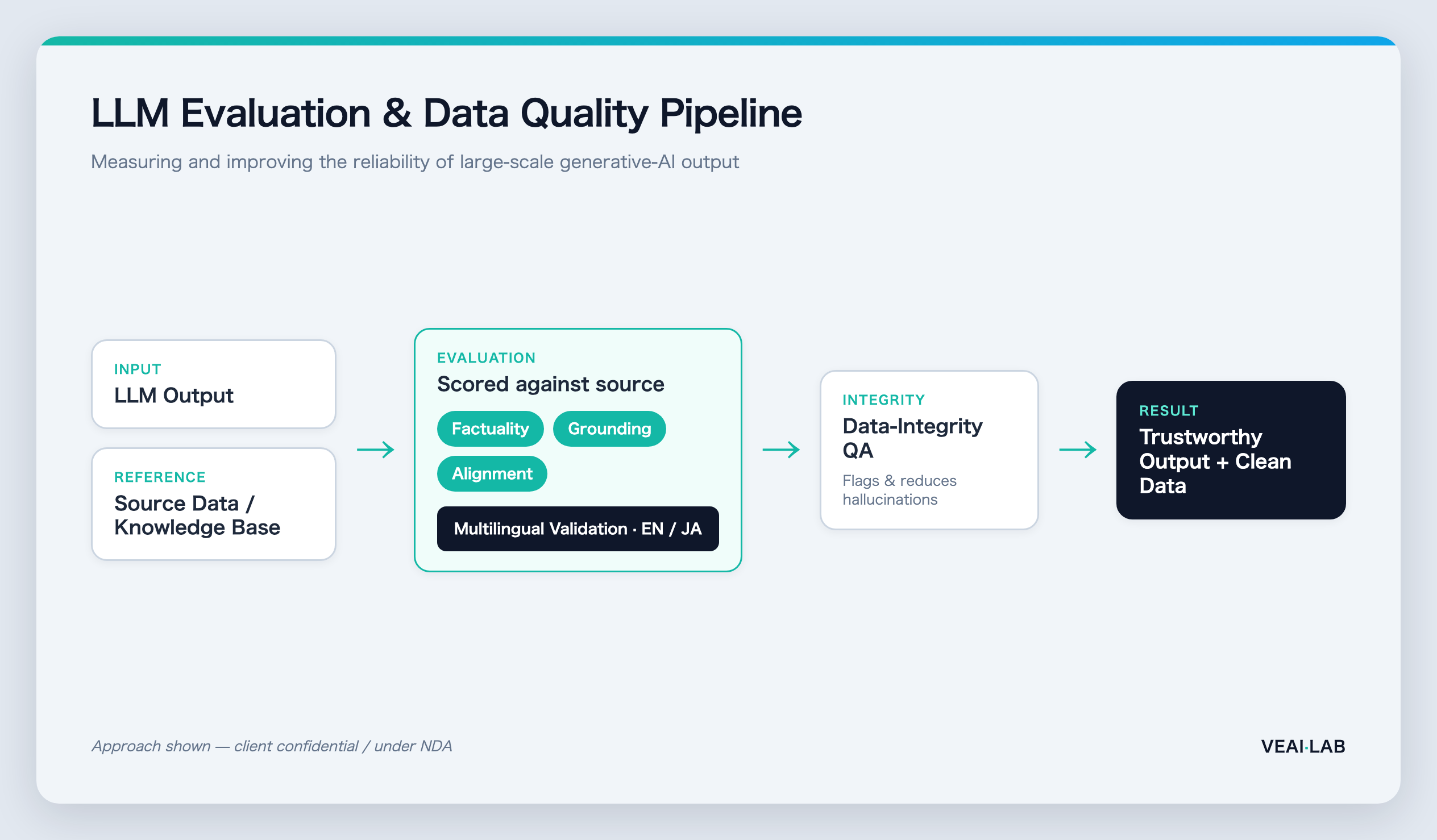
On a large-scale generative-AI platform, model output has to be reliable before it reaches users. As a senior (Level III) GenAI data-quality analyst, I evaluate LLM output for factuality, grounding, and alignment, run multilingual (English/Japanese) validation, and harden the underlying data — systematically reducing hallucinations at scale.
Context
A generative-AI system is only as trustworthy as its output. A fluent answer that is subtly wrong — a fabricated fact, a claim its own source doesn't support, or a response that quietly ignores the instruction it was given — is often more dangerous than an obvious error, because it reads as correct.
On a large-scale generative-AI / knowledge platform, my role is to catch exactly those failures before they reach users, and to keep the underlying data clean enough that the model has something reliable to reason over.
This engagement is confidential and under NDA. What follows describes my approach and methods — not the client, the product, or any proprietary detail.
Constraints
- Confidential (under NDA). No client, product, data, or proprietary methodology can be shown — only the general approach.
- Multilingual. Output must be validated in both English and Japanese; errors that pass a monolingual reviewer often surface only in the other language.
- Scale. Judgments have to stay consistent across large volumes and many reviewers, so "quality" must become a measurable, repeatable signal — not a matter of taste.
- Subtle failures. The hardest errors are the plausible ones: confident, well-formed, and wrong.
What I evaluate — three distinct axes
I score model output against its source and its instruction on three separate axes, because a response can pass one and fail another:
- Factuality — Is each claim actually true, checked against a reliable source? A fluent sentence is not evidence.
- Grounding — Is the answer supported by the context or documents the model was given, or has it drifted into unsupported territory — the root of many hallucinations?
- Alignment — Does the output follow the instruction, format, and policy it was asked to respect, rather than a reasonable-sounding tangent?
Multilingual (EN/JA) validation
Being bilingual is a data-quality tool, not just a language skill. The same output can be correct in English and subtly wrong in Japanese — a mistranslated entity, a lost nuance, a claim that no longer matches its source. I validate in both languages, so errors a monolingual pass would miss are caught and corrected.
Protecting data integrity
Model output is downstream of data. I curate and verify large-scale entity / knowledge-base data — fact verification, source reconciliation, and structural-integrity QA — so the platform reasons over clean, consistent information instead of propagating errors from the source upward.
Turning judgment into a signal
At scale, "this looks wrong" is not enough. I work from consistent rubrics and clear pass/fail criteria so that evaluation is repeatable across volume and reviewers, hallucinations are flagged the same way every time, and the results are usable as a measurable quality signal rather than one person's opinion.
Outcomes
- Model outputs are evaluated before they reach users, with fabricated and unsupported claims flagged and corrected.
- Multilingual errors that a single-language review would miss are caught in both English and Japanese.
- The underlying knowledge-base data is cleaner and more consistent, reducing the errors the model can inherit.
(Specific metrics are proprietary and cannot be shared under NDA.)
Honest limitations
- Evaluation is one layer, not a guarantee. It reduces hallucinations and catches errors; it does not make a model perfect.
- NDA limits what I can show. I can describe methodology and reasoning in a call, but not client, data, or numbers here.
- Human judgment stays in the loop. Rubrics make it consistent, but genuinely ambiguous cases still need a person — a feature, not a bug, for anything safety-adjacent.
Lessons
- Factuality, grounding, and alignment are different questions. Scoring them separately catches failures a single "is this good?" pass hides.
- Multilingual validation is a quality multiplier. A second language is a second, independent check on the same claim.
- Consistency beats brilliance at scale. A clear rubric applied the same way every time is worth more than one perfect judgment.
Evidence
This engagement is under NDA, so the artifacts can't be published. I'm glad to walk through the evaluation approach, rubrics, and multilingual methodology in a call.
Need your GenAI output to be trustworthy?
Hands-on LLM evaluation and data-integrity work — factuality, grounding, alignment, and multilingual validation.
Book a Free Consultation